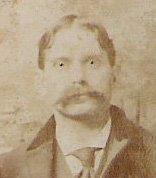
This is
Samuel Woodburn, my great-great-grandfather.
The following is a biographical entry printed in The History of Gibson County, Indiana (1914), by Gil R. Stormont, p p. 485–487:
Specific mention is made of many of the worthy citizens of Gibson county within the pages of this work, citizens who have figured in the growth and development of this favored locality and whose interests have been identified with its every phase of progress, each contributing in his sphere of action to the well-being of the community in which he resides and to the advancement of its normal and legitimate growth. Among this number is he whose name appears above, one of the foreign-born citizens of our commonwealth to whose industry and right principles of life the early development of our county and state is largely indebted for its high moral status. Samuel Woodburn is a native of county Antrim, Ireland, where he first saw the light of day on July 20, 1826, the son of Robert and Margaret (Wasson) Woodburn, both natives of the same county. The father was a farmer, and the parents spent their entire lives on their native sod. There were three children in the family, namely: Margaret, deceased; Samuel, subject of this sketch, and William, a farmer residing near Lockport, New York.
Samuel Woodburn received his education in the common schools of Ireland and early took up the work of a farmer. This vocation he followed until in 1847, when he set sail for America, being eleven weeks in crossing the Atlantic. His boat docked at New Orleans and from there he journeyed by boat up the Mississippi and Ohio rivers to Evansville, Indiana, and from thence to Princeton. His long journey was made in company with friends. His earliest employment here was during the construction of the Erie canal, in which he was employed for a time. He later became apprentice to the carpenter's trade, in which he became quite proficient and until he joined the army he worked steadily at this trade. In the fall of 1861 he enlisted in Company D, Fifty-eighth Regiment Indiana Volunteer Infantry, at Princeton. He was first sent to Louisville and Bardstown, Kentucky, and saw much, active service during his enlistment. He was in the battles of Pittsburg Landing, Murfreesboro, Stone River, Chattanooga, Duvalls Station, and other engagements and skirmishes. He was with the Army of the Cumberland. He had many close calls from death during the engagements in which he participated, but came through free from injury. He saw three years of service and. received his discharge in July, 1865. After his discharge from the army he returned to Princeton and again took up his work as a carpenter, at which he continued until he retired.
On November 20, 1856, Mr. Woodburn was united in marriage to Sarah Connor, who was born in Ireland, March 13, 1833. She was a daughter of Thomas Connor, who had emigrated to America and had settled in Vanderburgh County, Indiana [between 1842 and 1844]. To their union were born seven children: Robert, born September 29, 1857, a farmer of Center township, this county, married Belle Makemson. To them have been born six children, Munroe, Ethel, Hettie, Helen, Alva and Frank. The second child is James B., born May 19, 1859, a farmer who resides in Princeton and who married Josie Griffin. William, born July 6, 1861, is a farmer in White River township, this county; Mary J., who has always resided at home; Frank died July 30, 1867 [sic]; Henry, who resides in Evansville, married Dora Magerkurth and they have three children, Charles and Dorothy (twins) and Sarah E. The seventh child of Mr. Woodburn is Nellie, wife of Frank M. Terry, a traveling salesman of Princeton. Mrs. Woodburn's death occurred August 26, 1893 [sic].
Frank was born 2 Jul 1867and died 2 Apr 1899. Sarah died 26 Aug 1897.
Mr. Woodburn's religious sympathies are with the United Presbyterian church, to which he gives liberally of his time and means. He is also a member of the Grand Army of the Republic, Post No. 28, of Princeton. Mr. Woodburn is a hale old gentleman, a man of wonderfully rugged constitution which has served him well during the many years of hard work he has put in, and he is a man well known in the county. He has made many friends both through his business connections and by reason of his genial personality and universal good nature. He is accounted among the most worthy citizens of Gibson county, one who has always had the best good of the community at heart.
http://www.rootsquest.com/~jmurphy/gibson/stormont.htmThe following is an article from The Princeton Democrat regarding the life of Samuel the day after his passing, 29 January 1915: 
In His 89th Year Samuel Woodburn Is Called To His Reward
The End Came Thursday Night – Was One of Princeton’s Oldest Citizens – Funeral SaturdaySamuel Woodburn, Princeton’s oldest citizen, died Thursday night at 9:45 o’clock at his home, 704 north Main street, after a brief illness with heart ailment. Though feebler in the last few months, Mr. Woodburn had been in his usual health and up and around until two or three days ago, when he suffered a serious attack. However, he was believed to be improving. Thursday he grew worse and it was realized the end was near. Mr. Woodburn was in his 89th year [sic]. 88 years old.
The funeral will be held at the family residence Saturday afternoon at 2:30 o’clock, conducted by Rev. Morris Watson, of th
e United Presbyterian church, and internment will be at Odd Fellows cemetery. The Archer post will attend the services in a body. [Archer was Princeton’s branch of the Grand Army of the Republic, a Civil War organization similar to today’s VFW.]
Samuel Woodburn was born in County Antrim, Ireland, July 20, 1826, the son of Robert and Margaret Woodburn, and there his youth was spent on his father’s farm. In 1847 he sailed to America. The vessel was eleven weeks in making the crossing. Finally landing at New Orleans, he made his way to Princeton and for a while was employed on the construction of the Erie canal through this country. Later he took up the carpenter’s trade, which he followed until his retirement from active life.
In the fall of 1861 he enlisted in Co. D, 58th Indiana regiment, and served three years, until July 1865. He was known as one of the bravest men of his company and served in some of the heaviest engagements of the was. He was a member of the Archer Post, G.A.R., and was never happier than when with his old comrades recounting the stirring days of the war. His remarkable good memory enabled him to give most graphic descriptions of some of the scenes then enacted.
On November 20, 1956, he was united in marriage to Miss Sarah Conner, a native of Ireland and to them were born seven children, all of whom survive except one, Frank who passed away in 1899. The wife and mother was called home August 27, 1897. Robert, James B., William, Harry, Miss Mary J. Woodburn and Mrs. F.M. Terry, all of this city and vicinity, are the surviving children.
Mr. Woodburn was one of Princeton’s most esteemed men. His cheery disposition, his friendly word for everyone, made him loved by all who knew him, and not alone in the family circle, but among the comrades and friends everywhere the lack of his kindly presence will be deeply felt.
 Robert, Frank & Harry Woodburn, c. late 1880's